
Atmospheric Science Lesson 4: Keys to a successful scientific field campaign
NOTES: We have some checklists from 2020 Still not sure if there will be Lesson 4 to cover BOTH tracks, or if it is separate? There is lesson in science and other "generic" in LESSONS as of 1/2/23. there are several named versions of this lesson; this is the right one!!
Overview
This lesson will describe the process that we go through to plan, execute and manage the data that comes from a scientific field campaign. You will learn about the key components of a field campaign -- before, during and after -- and learn about the field campaign process by studying an authentic field campaign called Wintre-Mix before turning your attention to the planning of your NEBP campaign.
This lesson also includes key strategies for building diverse teams; finding funding for a project; managing data from the campaign; and communicating results.
Learning objectives
After completing this lessons, students will be able to:
- Identify the key components of a field campaign
- Describe the process for identifying a focus for the campaign — what you want to study
- Name key considerations for:
- who should be on the research team, including why diversity is important when forming a team
- where the campaign should take place, including potential logistical challenges
- when your observations should be collected - season, length of time, etc.
- resource limitations - financial, staffing, etc.
- what instruments you may need
- how you will deploy and operate the instruments to address your research goals
- Describe potential funding constraints, strategies and sources
Executing a field campaign
Atmospheric science field campaigns are a rewarding and vital part of our science.A successful campaign is a multi-faceted undertaking that extends far beyond the field deployment period, including
- Identifying focus, planning, securing resources
- Field operations
- Data management, [analysis], communication
We need collaborative and diverse teams with varied skills to pull this off!
Field operations
Once your campaign has secured funding, it is time to plan and execute the fieldwork. These are key considerations and overarching concerns.
1. Diversity, Equity, Inclusion (DEI)
-
Vital to insure a safe and supportive environment for all team members.
-
Fieldwork can present challenges for DEI that are not found on campus and in the office. It is important to be cognizant of and plan for the various challenges.
-
Long hours
-
“Informal” settings
-
High stress
-
Physically challenging work
-
-
Clear policies and expectations are important. How will we work around these challenges to achieve a supportive and inclusive environment?
2. Safety
Safety is critical to the campaign's success. Consider:
- Adequate rest hours
- Safe use of equipment
- Travel safety (esp. with dangerous weather)
- Health procedures
- and many others
3. Compliance
We must comply with rules/laws at theinstitutional, municipal, state, federal levels
Examples:
-
FAA rules for uncrewed balloon flights (see also Lesson 9) - include link
-
International import/export
-
FCC rules for radar transmission
Operations planning and decision making
Many campaigns require important decisions be made about how to operate, and you must balance many factors.Operations often focus on intensive observing periods (IOPs) that need to be selected.
Examples of operational decisions include: balloon launch times, aircraft flight tracks, and radar/lidar scanning strategies
Often, they are weather-dependent:Good forecasting/communication is vital and nearreal-time display of observations is very useful
Operational decisions need to balance many factors:
- Scientific goals (can be varied / conflicting) •
- Safety
- Resource limitations (expendables, flight hours, ...)
- Forecast uncertainty
NOTE: Video has specific clips toward the end about data management and communicating within the team and to the public. these could be useful in other lessons, too - hyperlinks or short clips
Resources
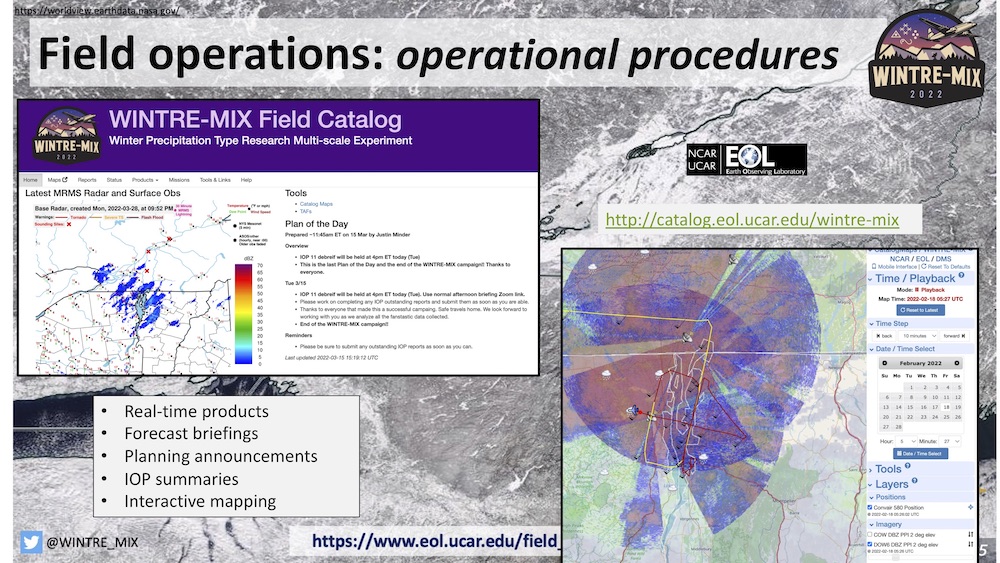
- Overview of scientific field campaigns - by Dr. Justin Minder, University of Albany. [YouTube video 56:14]
- View or download the slide deck here
Below info is old from 2020 campaign - do we still want this? The bullet lists seem ok; the checklsits seem really specific and maybe should be in a later lesson
Key tips and checklists for a successful field campaign
Preparedness
- We build redundancy into our flight system and packing plan.
- Know the system well enough to solve a problem quickly.
- We cannot anticipate everything- know the system.
- Be well trained.
Training
- Learn something new every flight.
- Teach a teammate something new every flight.
- Communicate clearly & listen respectfully.
- Slow is smooth, smooth is fast.
These should probably be moved to another lesson
Checklists
Initializing the radiosondes
[You can also download a PDF of this document; same content as below]
- Connect the radiosonde to the ground station and verify signal
- Setup the GRAW sounding
- Disconnect the radiosonde and acclimate
- Run helium fill calculator
- Save data
Operating the Lufft
- Record weather conditions from Lufft
- Attach parachute and dereeler to radiosonde and check for snags
- Record helium tank fill level pre- and post-flight
- Act as a floater during fill
Primary Fill
[You can also download a PDF of this document; same content as below]
- Stage helium tanks for fill
- Unpack balloon and attach to fill nozzle
- Manage fill rate
- Hold balloon while sonde is attached
- Release the balloon on time
Secondary fill
[You can also download a PDF of this document; same content as below]
- Receive radiosonde from acclimation
- Attach radiosonde to balloon
- Double check line for loops or tangles
- Cut safety line
- Allow radiosonde and dereeler to be lifted from hands
Homework / Extended learning
Wintre-Mix case study
Visit the Wintre-Mix project website and look for the key components that Dr. Minder describes in his video presentation or visit another field campaign website and look for the key components of the campaign.
Learn about implicit bias
Implicit bias is an automatic reaction we have towards other people. These attitudes and stereotypes can negatively impact our understanding, actions, and decision-making. The idea that we can hold prejudices we don’t want or believe was quite radical when it was first introduced, and the fact that people may discriminate unintentionally continues to have implications for understanding disparities in so many aspects of society, including but not limited to health care, policing, and education, as well as organizational practices like hiring and promotion.
 Project Impact is a non-profit organization and international collaborative of researchers
who are interested in implicit social cognition—attitudes and beliefs that are largely outside of our conscious awareness and control.
Project Impact is a non-profit organization and international collaborative of researchers
who are interested in implicit social cognition—attitudes and beliefs that are largely outside of our conscious awareness and control.
The organization offers a number of free, online Implicit Association Tests (IAT) that advance your own self-understanding of the attitude or stereotype of topics including race, gender, sexuality, age and weight, among others. The IAT may be especially interesting if it shows that you have an implicit attitude that you did not know about.
We recommending taking the online tests in private. You may choose to report your results anonymously to the research team or simply view them privately. You do not need to share your results with your NEBP or classmates. You may be surprised at what you find.
Visit Project Implicit, then click TAKE A TEST. You may choose from several tests. Because we are a STEM project, we recommend, in particular, that you take the Gender-Science IAT.
The IAT site is designed for adults, aged 18 or older.
Course home page // Next lesson >>